

Swing Hook vs. Fixed Hook Bucktail Jigs: Which One Gets You More Hookups?
![[HERO] Swing Hook vs. Fixed Hook Bucktail Jigs: Which One Gets You More Hookups?](https://cdn.marblism.com/VihESrtsgNG.webp)
If you’ve spent any time in a tackle shop or scrolling through fishing forums, you’ve probably stumbled into the great debate: swing hook or fixed hook bucktail jigs?
It’s one of those topics that can spark a heated conversation at the boat ramp. Some guys swear by the classic fixed hook design their grandpa used. Others won’t touch anything but a swing hook after losing one too many fish at the boat.
So which one actually gets you more hookups? And more importantly, which one keeps those fish pinned until they hit the net?
Let’s break it down. No fluff, no marketing speak, just the facts so you can make the right call for your next trip.
What Is a Fixed Hook Bucktail Jig?
Let’s start with the OG. The fixed hook bucktail jig is exactly what it sounds like: the hook is molded directly into the lead head. It’s one solid, rigid piece. The hook doesn’t move, pivot, or swing. It’s locked in place.
This is the traditional design that’s been catching fish for generations. When you think of a classic bucktail jig, this is probably what comes to mind.
The appeal? Simplicity. There are no moving parts, nothing to fail, and nothing to think about. You tie it on and go fishing.
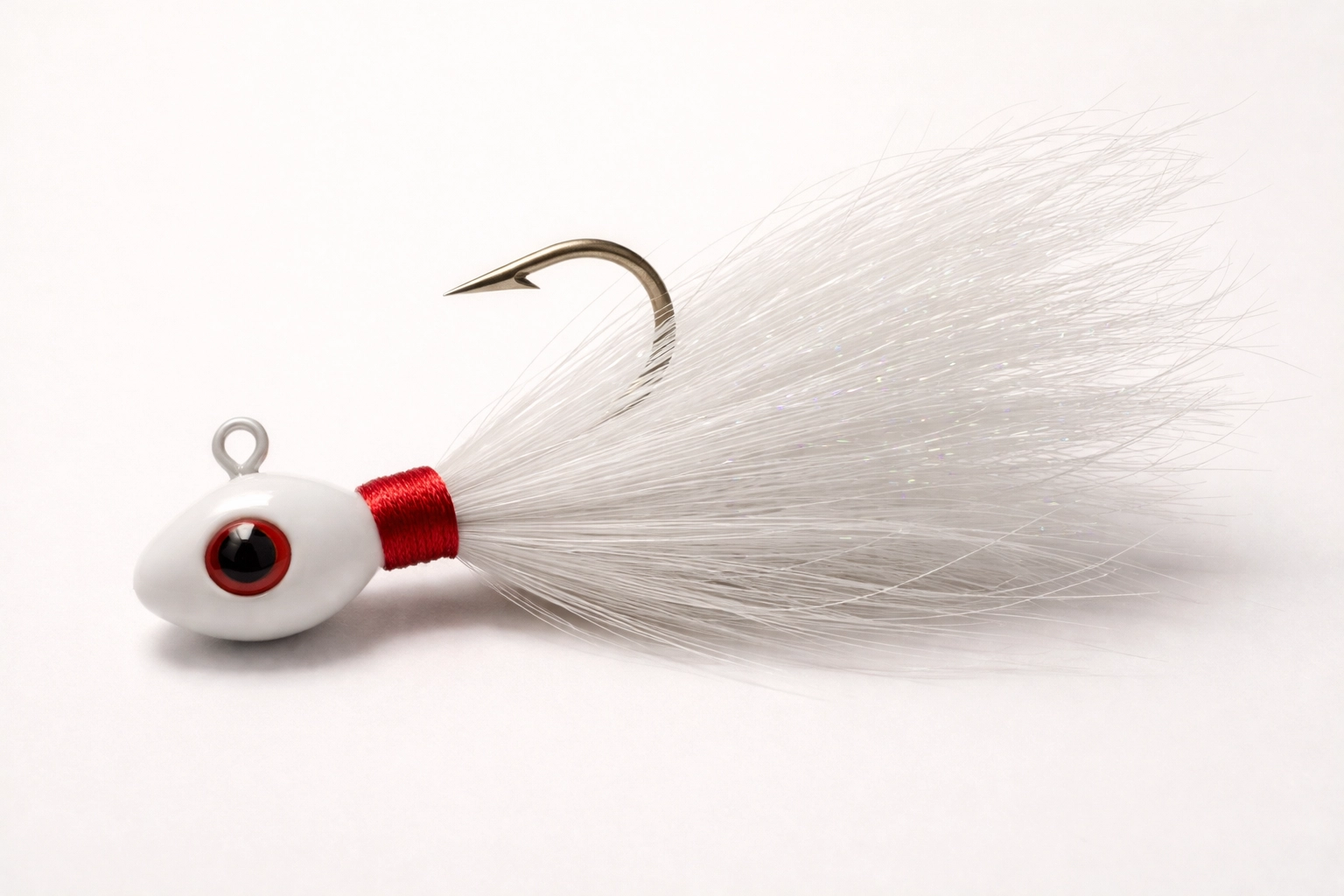
What Is a Swing Hook Bucktail Jig?
A swing hook bucktail jig separates the hook from the jig head using a hinge or swivel connection. The hook is free to pivot and move independently from the weight.
Think of it like this: instead of a rigid, one-piece design, you’ve got two components working together but moving separately. The head does its job (getting your bait down and providing action), and the hook does its job (sticking fish).
This design has been gaining serious traction over the past several years, especially among fluke, striped bass, and inshore anglers who got tired of watching fish throw the hook at the worst possible moment.
The Leverage Problem (And Why It Matters)
Here’s where things get interesting, and where the swing hook really starts to shine.
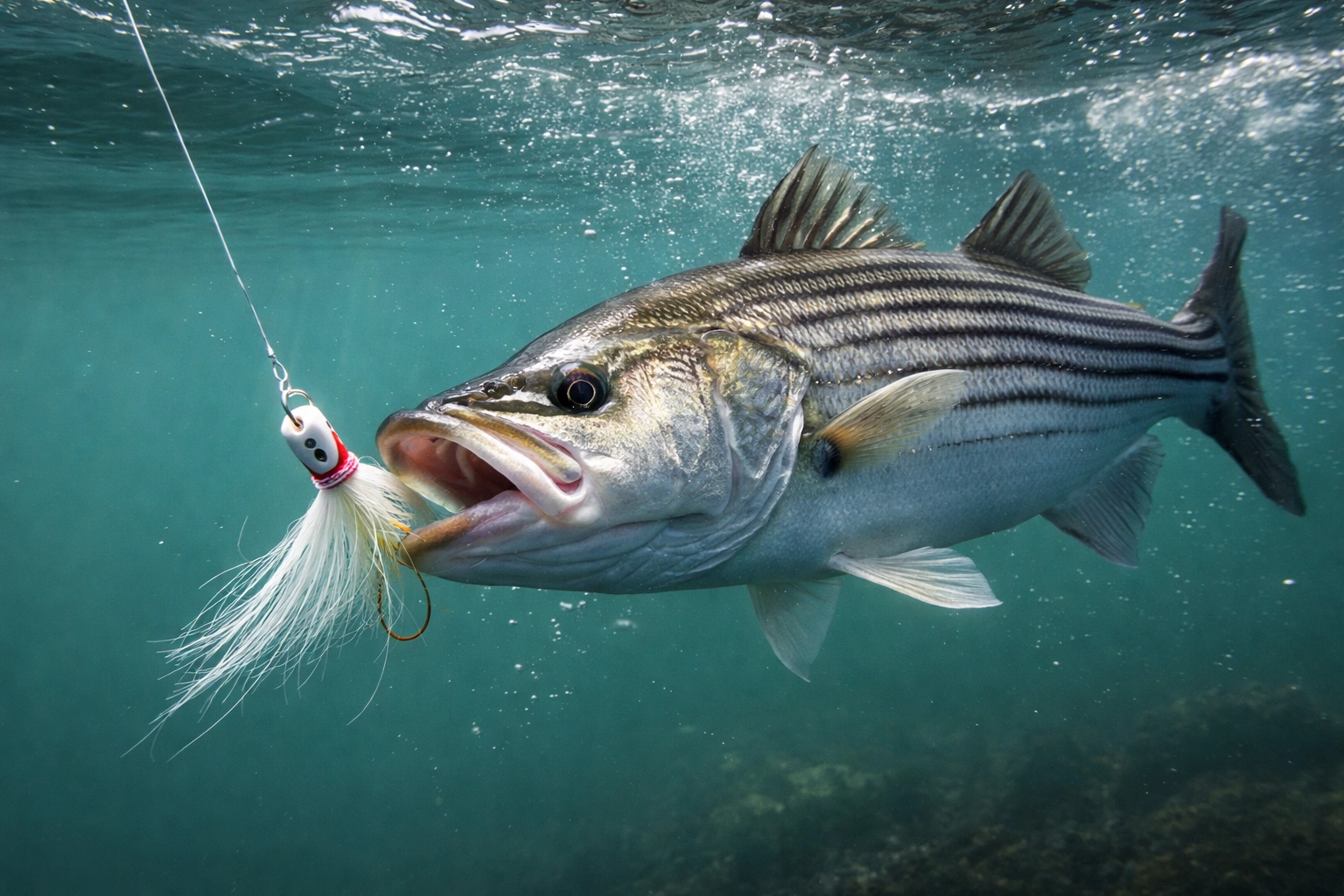
When a fish eats your bucktail and realizes something’s wrong, it’s going to do everything in its power to get rid of that hook. Headshakes, rolls, thrashing at the surface, you’ve seen it. That’s the moment where hookups turn into heartbreak.
With a fixed hook, the weight of the jig head is rigidly connected to the hook. When that fish thrashes and shakes, it can use the mass of the lead head as leverage to pry the hook loose. Every headshake transfers energy directly to the hook point, working it back and forth in the fish’s mouth. Given enough time and enough violent shakes, that hole gets bigger and the hook pulls free.
We’ve all been there. You’re fighting a nice fish, it makes one good head shake at the boat, and suddenly you’re staring at a slack line wondering what went wrong.
With a swing hook, the physics change entirely. Because the hook pivots freely on that hinge point, the fish can’t use the jig head’s weight as a lever. When it shakes its head, the heavy lead head swings around independently while the hook stays put. The fish is essentially fighting the hook alone, not the hook plus a chunk of lead working against you.
Bottom line: Swing hooks make it significantly harder for fish to throw the hook during the fight. That’s not just theory, ask any tackle shop owner who’s heard the same story a thousand times from frustrated anglers.
Fixed Hook Bucktail Jigs: Pros and Cons
Let’s give the fixed hook its fair shake. It’s been catching fish forever for a reason.
Pros:
- Simplicity – One piece, no moving parts, nothing to fail
- Durability – There’s no hinge or connection point that can wear out
- Direct hooksets – Some anglers feel they get a more immediate hookset with a rigid connection
- Familiar feel – If you’ve been fishing bucktails for decades, this is what you know
- Often less expensive – Simpler manufacturing can mean a lower price point
Cons:
- The leverage problem – Fish can use the jig head weight to work the hook free
- Mouth damage – The rigid connection puts more stress on the fish’s mouth, creating larger holes that make it easier for hooks to pull
- Less natural bait movement – When tipping with strip bait or soft plastics, the fixed connection can restrict how naturally your trailer swims
Swing Hook Bucktail Jigs: Pros and Cons
Now let’s look at the modern contender.
Pros:
- Better hookup retention – Fish can’t leverage the weight to throw the hook
- Reduced mouth damage – Less pressure on the puncture point means smaller holes and better hook retention throughout the fight
- More natural bait action – Strip baits and soft plastics swim more freely and naturally
- Ideal for catch-and-release – Less mouth damage means healthier releases
- Confidence factor – Once you’ve landed a few fish that would have come unbuttoned on a fixed hook, you’ll understand
Cons:
- Slightly more complex – There’s a moving part that could theoretically fail (though quality construction makes this rare)
- Different feel – Takes some getting used to if you’ve fished fixed hooks your whole life
- Can be pricier – The added hardware and construction can add to the cost
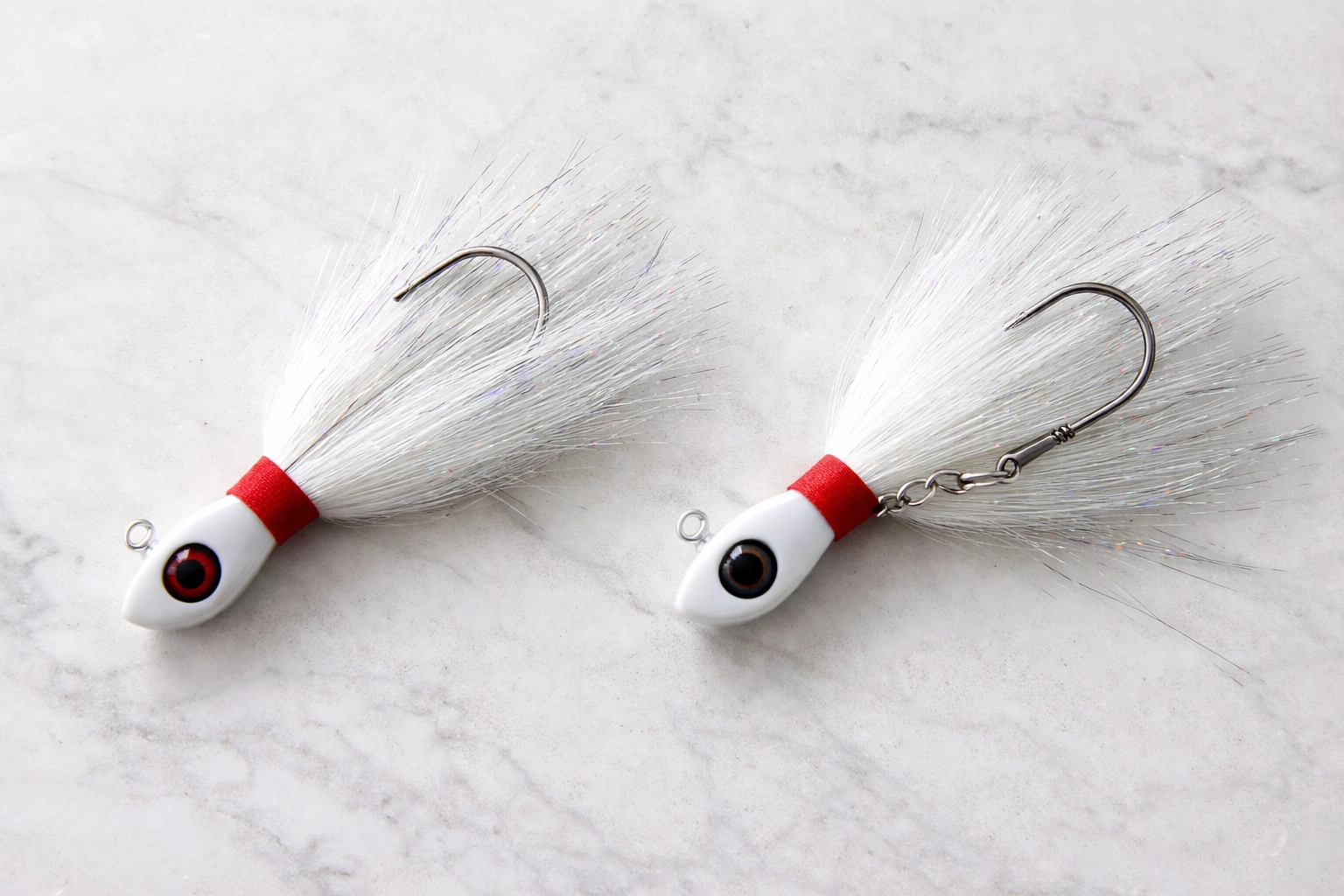
When Should You Use Each Design?
Here’s the straight talk: both designs catch fish. If someone tells you one is completely useless and the other is magic, they’re oversimplifying.
That said, there are situations where each design has an edge.
Consider a fixed hook when:
- You’re fishing heavy structure where a simpler, more snag-resistant profile helps
- You prefer the traditional feel and aren’t losing fish to thrown hooks
- Budget is a major concern and you’re burning through jigs in gnarly terrain
Consider a swing hook when:
- You’re targeting species known for violent headshakes (stripers, fluke, etc.)
- You’ve been losing fish during the fight and can’t figure out why
- You’re tipping with bait or soft plastics and want the most natural presentation
- Catch-and-release is important to you and you want to minimize mouth damage
For most anglers targeting striped bass, fluke, and similar species? The swing hook is going to put more fish in the boat over the course of a season. The physics just work in your favor.
Our Ultra Minnow Bucktail Jigs: Swing Hook Design, American Made
At Bucktail Lures, we build our Ultra Minnow Bucktail Jigs with a swing hook design for exactly the reasons we’ve been talking about. We got tired of hearing stories (and living them ourselves) about quality fish lost to thrown hooks.
The Ultra Minnow features a sleek minnow-profile head paired with a free-swinging hook that lets fish fight all they want without giving them the leverage to escape. It’s the kind of jig we wanted in our own tackle boxes: so we built it.
And like everything we make, it’s manufactured right here in the USA with premium components. No corners cut, no overseas shortcuts. Just serious tackle built by a family that actually fishes this stuff.
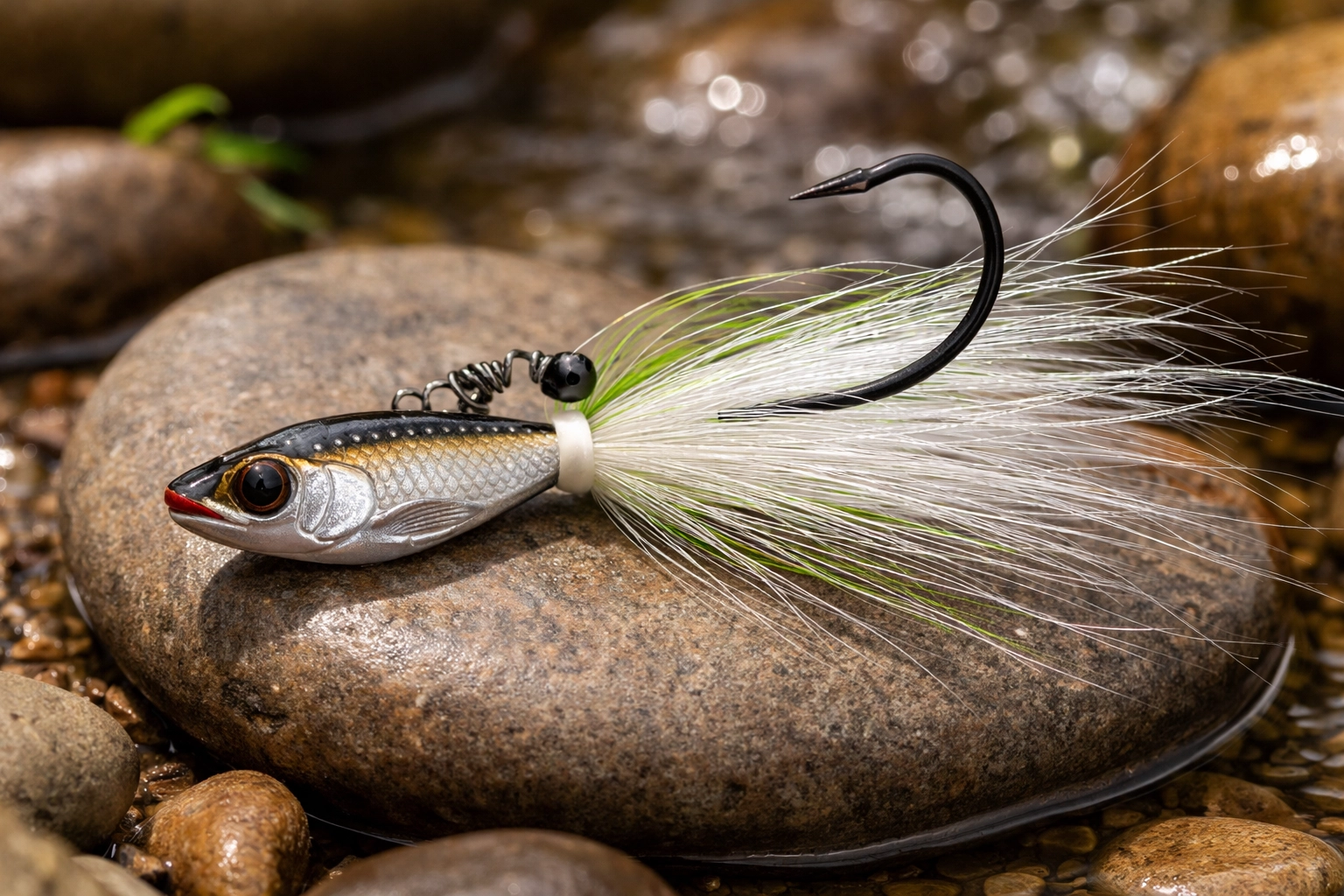
The Verdict
Look, at the end of the day, the best jig is the one you have confidence in. Both fixed and swing hook bucktails have their place.
But if you’ve been losing fish and can’t figure out why: or if you’re chasing hard-fighting species that love to throw hooks: it might be time to give swing hooks an honest shot.
The science is simple: take away the leverage, and you take away the fish’s best weapon for escape.
Tight lines out there.
Ready to upgrade your bucktail game? Check out our full lineup of American-made jigs, including swing hook options, at bucktaillures.com/shop.
How to Choose the Best Jig Head Weight for Any Depth or Current (Compared)
![[HERO] How to Choose the Best Jig Head Weight for Any Depth or Current (Compared)](https://cdn.marblism.com/fEbeOl6FU3m.webp)
Ever watch your jig head lures disappear into the water and wonder if they’re actually getting down to where the fish are? Or maybe you’ve felt that frustrating moment when your bucktail jigs keep getting swept away by current before they even hit the strike zone.
Here’s the deal: picking the right jig head weight isn’t just some minor detail, it’s often the difference between a cooler full of fish and a long day of casting practice.
Let’s break down exactly how to choose the right weight for any situation you’ll encounter on the water.
Why Jig Head Weight Actually Matters
Think of your jig head weight as the engine that drives your entire presentation. Too light, and you’re fishing above the fish. Too heavy, and you’re plowing through the bottom like a bulldozer, spooking everything in sight.
The goal is simple: get your lure into the productive zone and keep it there long enough to trigger a strike. But “the productive zone” changes constantly based on water depth, current speed, and what the fish are doing that day.
Understanding this relationship between weight and presentation is what separates anglers who consistently catch fish from those who just get lucky now and then.
The Basic Rule: Depth + Current = Weight
Here’s your starting formula. It’s not complicated, but it works:
Shallow water + slow current = lighter jig heads
Deep water + fast current = heavier jig heads
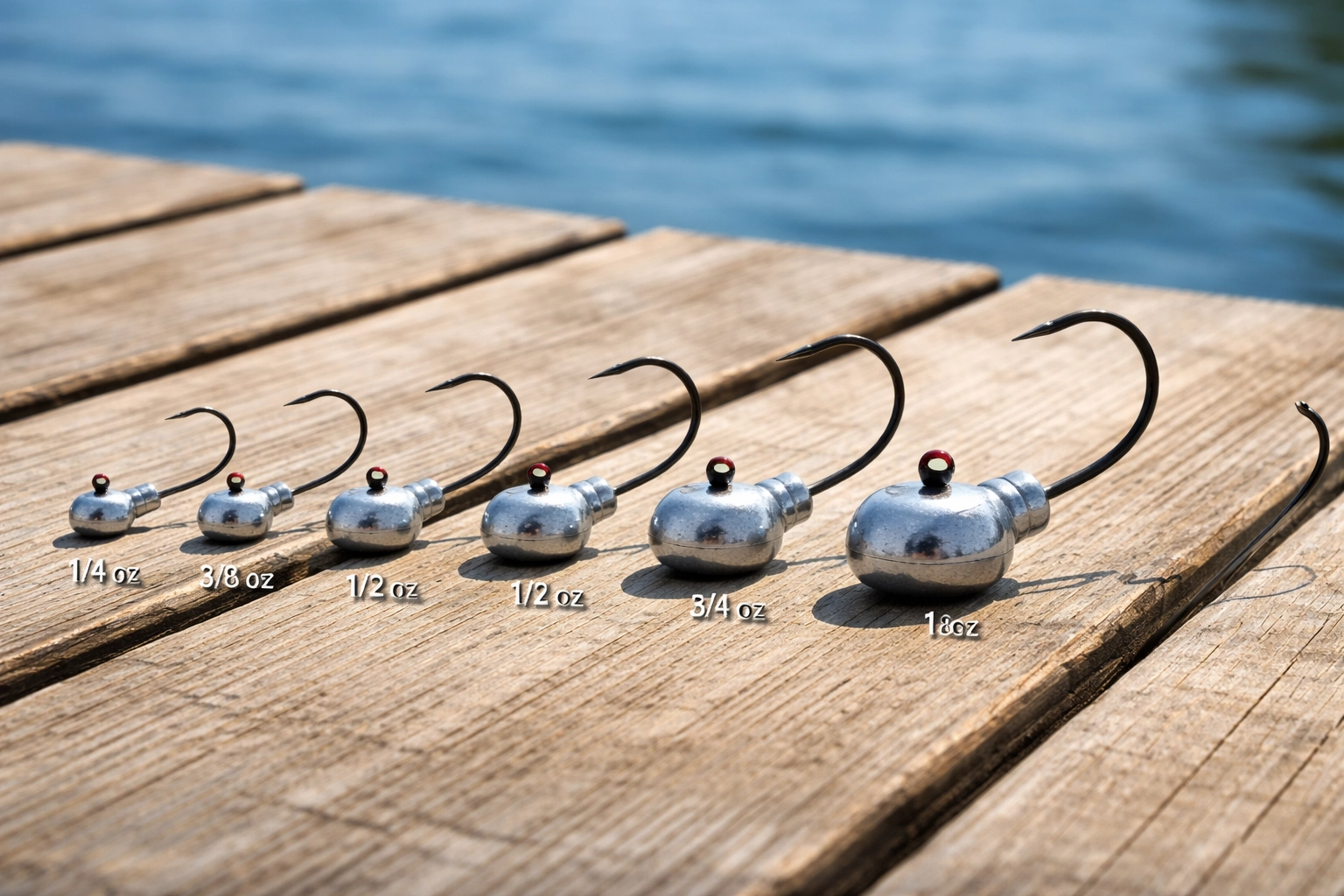
Lighter bucktail jig heads give you a slower, more natural drop through the water column. Fish get a better look at your presentation, and it mimics the way real baitfish move. This is exactly what you want when you’re working shallow flats or targeting fish that are relating to structure near the surface.
Heavier jig heads punch through the water column fast. They get down to depth quickly and stay in the strike zone even when current is trying to sweep them away. When you’re fishing deep channels or battling serious tidal flow, you need that extra weight to maintain control.
Weight Recommendations by Condition
Let’s get specific. Here’s what actually works in real-world conditions:
Shallow Water (Under 10 feet, Light Current)
Go with 1/4 to 3/8 ounce
This is your finesse zone. You want that slow, tantalizing fall that gives wary fish time to commit. In water with low visibility (less than 2 feet), stay on the lighter end, 3/8 ounce or less. The slower presentation gives fish more time to locate your lure by feel and sound.
Medium Depth (10-25 feet, Moderate Current)
Stick with 1/2 to 5/8 ounce
This is the sweet spot for most situations. If you could only carry one weight range in your tackle bag, this would be it. A 1/2 ounce jig head handles a surprising variety of conditions and gives you enough weight to cast accurately while still maintaining a natural presentation.
Deep Water or Heavy Current (25+ feet or Strong Tidal Flow)
Bump up to 3/4 to 1 ounce
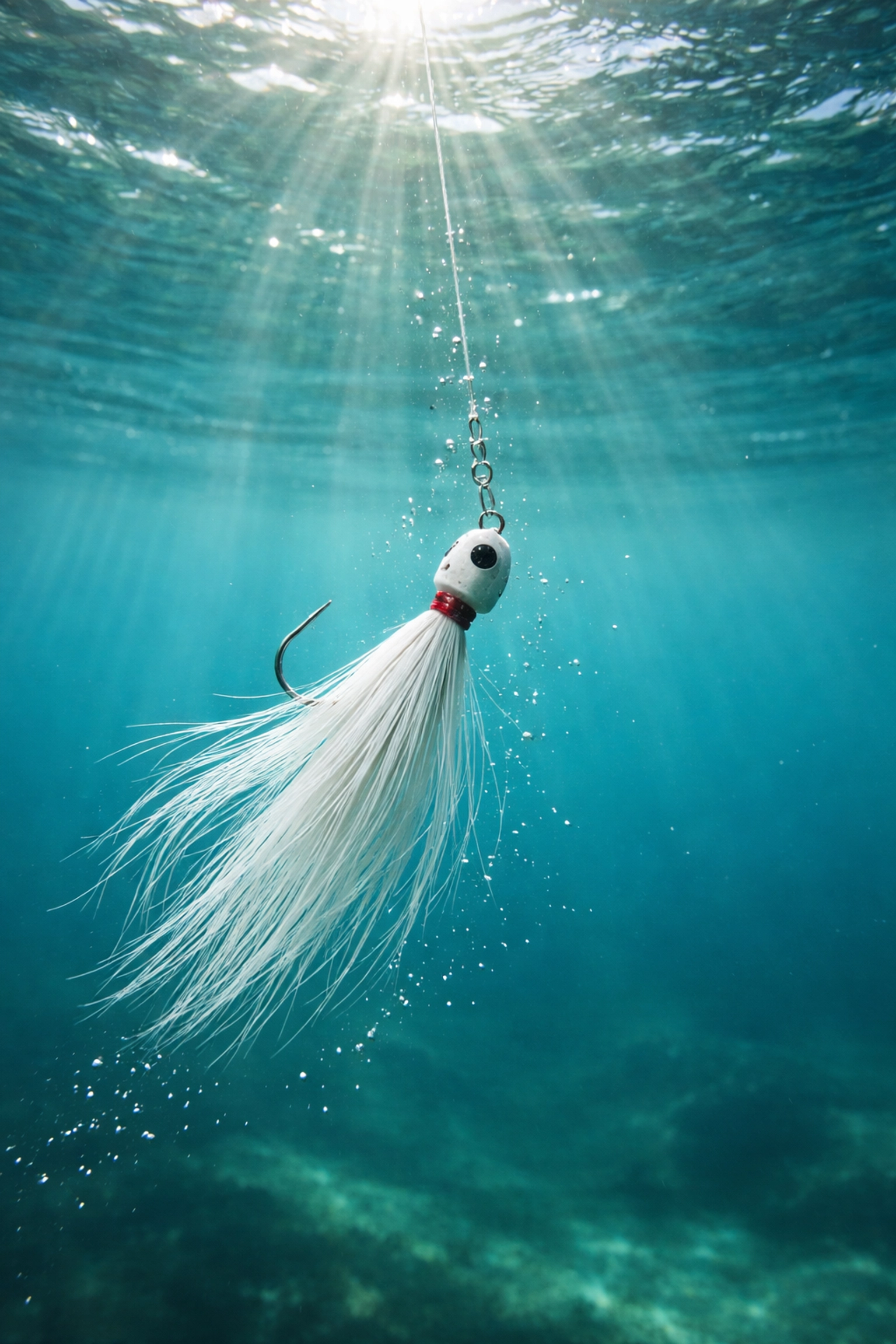
When you’re fishing deep structure, working heavy current, or trying to punch through thick vegetation, don’t be shy about going heavy. A 3/4 ounce or 1 ounce jig head gets down fast and stays where you put it. Yeah, you sacrifice some of that natural fall: but if your lure never reaches the fish, it doesn’t matter how pretty the presentation is.
Other Factors That Affect Your Weight Choice
Depth and current are the big two, but they’re not the whole story. Here’s what else you should be thinking about:
Wind Conditions
Windy days are the enemy of light jig heads. When you’re fighting a 15-mph crosswind, that 1/4 ounce bucktail jig becomes almost impossible to cast accurately. Bumping up a size or two gives you better casting control and helps you actually put the lure where the fish are.
Target Species
Different fish call for different approaches. If you’re chasing striped bass or other large predators, you might want a heavier jig head simply for the hook strength and durability. Bigger fish put more stress on your gear, and quality bucktail jigs built with premium components handle that abuse better than bargain-bin alternatives.
Line and Leader Weight
Your tackle setup matters here. Heavier line and higher drag settings pair naturally with heavier jig heads. If you’re running light braid with a thin fluorocarbon leader, a super-heavy jig head can actually hinder your presentation. Match your weight to your overall setup.
Trailer Size and Style
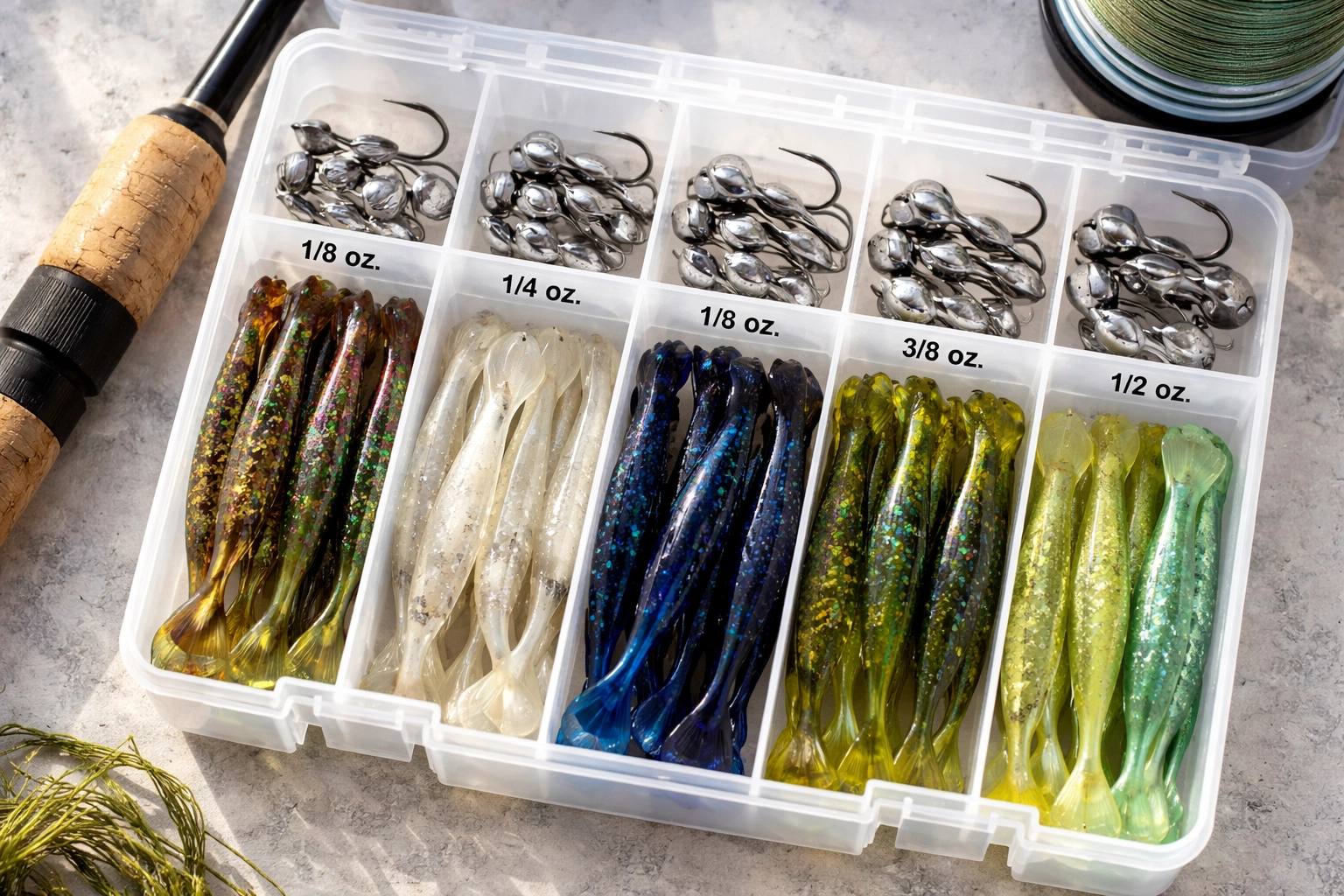
Here’s one that trips up a lot of anglers: changing your soft plastic trailer changes your sink rate. A bulky trailer with lots of appendages creates more resistance and slows your fall. If you swap from a slim paddle tail to a chunky creature bait, you might need to go up in jig head weight to maintain the same drop speed.
The On-Water Adjustment Strategy
Here’s how the pros approach jig head weight selection:
Start with a baseline weight based on the conditions you’re seeing: water depth, current speed, and the factors we just covered.
Carry options on both sides of that baseline. If you’re starting with 1/2 ounce, have 3/8 ounce and 3/4 ounce ready to go.
Pay attention to what your jig is telling you. Can you feel the bottom? Is your lure staying in the strike zone or getting swept away? Are you getting bites on the fall or after the lure settles?
Adjust throughout your session. Conditions change. Tide shifts. Current picks up or dies down. The anglers who catch fish all day are the ones who adapt instead of stubbornly sticking with what worked an hour ago.
If you’re not getting bites, try going heavier first. Often the issue is that you’re simply not reaching the depth where fish are holding. Once you’re confident you’re in the zone, then consider going lighter for a more natural presentation.
Why Quality Jig Heads Make a Real Difference
Let’s talk about something that doesn’t get enough attention: not all jig head lures are created equal.
Cheap jig heads might save you a few bucks, but they cost you fish. Inconsistent weights mean you can’t trust your presentation. Weak hooks straighten out on big fish. Poor paint jobs chip off after a few casts.
This is exactly why we build our bucktail jig heads right here in the USA with premium components. Our Pro Shad Jig Heads and Ultra Minnow Bucktail Jigs are designed for anglers who take their fishing seriously. Consistent weights, razor-sharp hooks, and durable finishes that hold up season after season.
When you’re making dozens of weight-based adjustments throughout a fishing day, you need gear you can trust. Quality components aren’t just about durability: they’re about confidence in your presentation.
Quick Reference Chart
Here’s a cheat sheet you can screenshot for your next trip:
| Condition | Recommended Weight |
|---|---|
| Shallow, calm water | 1/4 – 3/8 oz |
| Medium depth, light current | 3/8 – 1/2 oz |
| Medium depth, moderate current | 1/2 – 5/8 oz |
| Deep water or strong current | 3/4 – 1 oz |
| Heavy wind (add to baseline) | +1/8 – 1/4 oz |
| Bulky trailer (add to baseline) | +1/8 oz |
Put It Into Practice
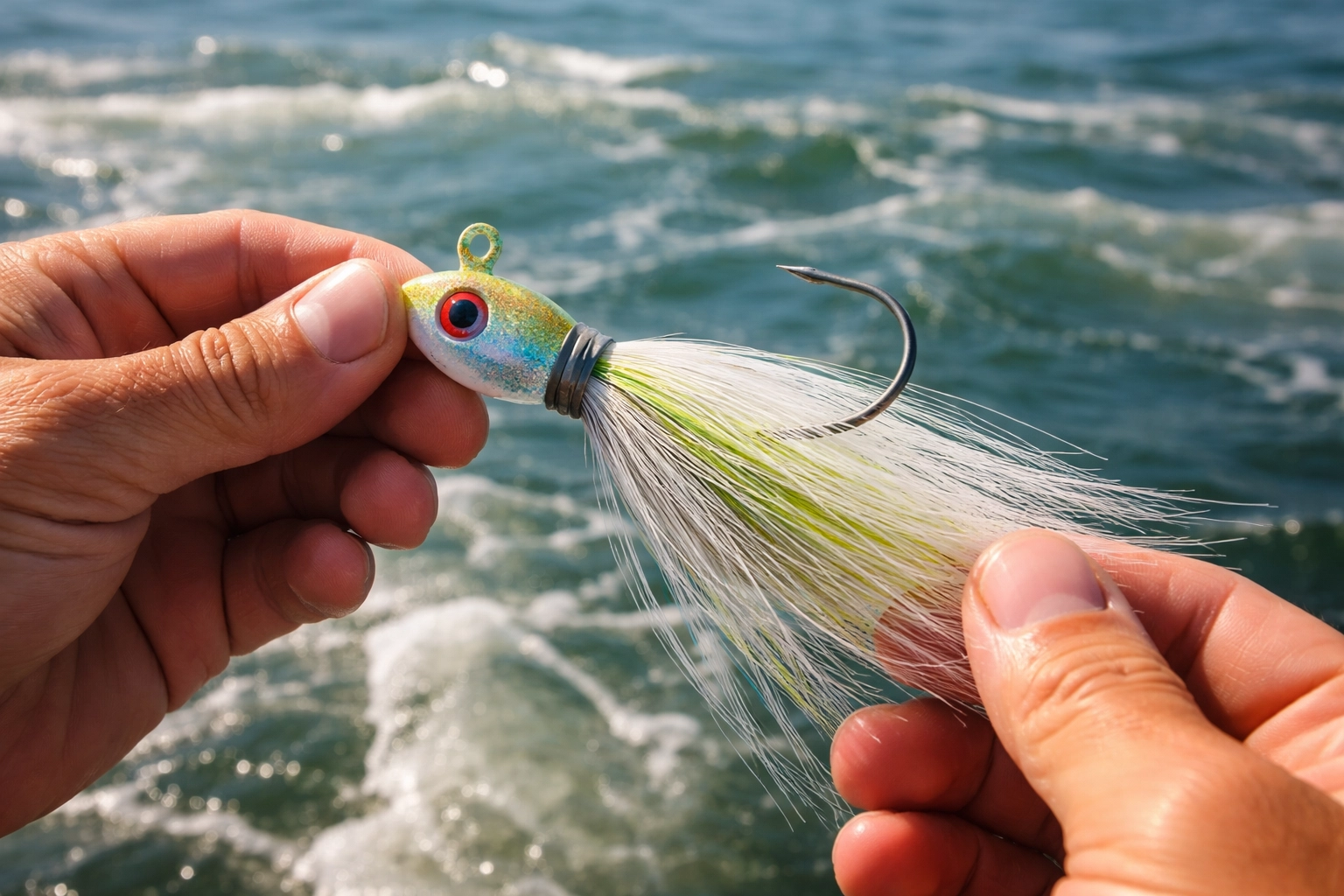
Choosing the right jig head weight isn’t rocket science, but it does take some thought. Start with the depth and current you’re facing, factor in wind and your trailer choice, then be willing to adjust as conditions change.
The anglers who consistently put fish in the boat aren’t the ones with the fanciest gear or the secret honey holes. They’re the ones who pay attention to the details: like making sure their bucktail jigs are actually reaching the fish.
Ready to upgrade your jig head game? Check out our full lineup of Made in USA jig heads and bucktail lures built for serious anglers who demand performance.
Now get out there and put this knowledge to work.